We were asked by a customer, after reading our earlier piece on Retell, Vapi, and the difference between a framework and a platform, why we kept coming back to the prompt as the architectural battleground. Their question was sharper than the article had been: "What happens when you want one agent to do six different things? How does that even fit in a single prompt?"
It was a fair challenge. The original article focused on prompt isolation between tenants — a fix made for one customer never travels to another. The customer's question pointed at the same problem viewed from a different angle: prompt isolation inside one agent, when that agent needs to do many distinct things stitched together in one prompt.
This is the single-prompt skills problem, and it shows up the moment a real business tries to use an AI receptionist for more than a single, narrow task.
What a "skill" actually is
Most real businesses do not have one job for the agent to do. A plumber's after-hours line might need to triage genuine emergencies, book non-urgent jobs, take messages, answer questions about pricing, route warranty enquiries to the right person, and refuse to give quotes the business owner has not approved. A dental practice might want appointment booking, prescription enquiries, new-patient intake, billing questions, and an out-of-hours triage script that escalates a dental abscess but politely declines an appointment.
Each of those is a skill. Each has its own goal, its own conversational shape, its own data to collect, and its own definition of success. A booking skill needs to capture date, time, service type, and contact details. An emergency triage skill needs to score severity and decide whether to fire an outbound voice alert. A billing-question skill needs to read from a knowledge base and avoid making commitments about refunds.
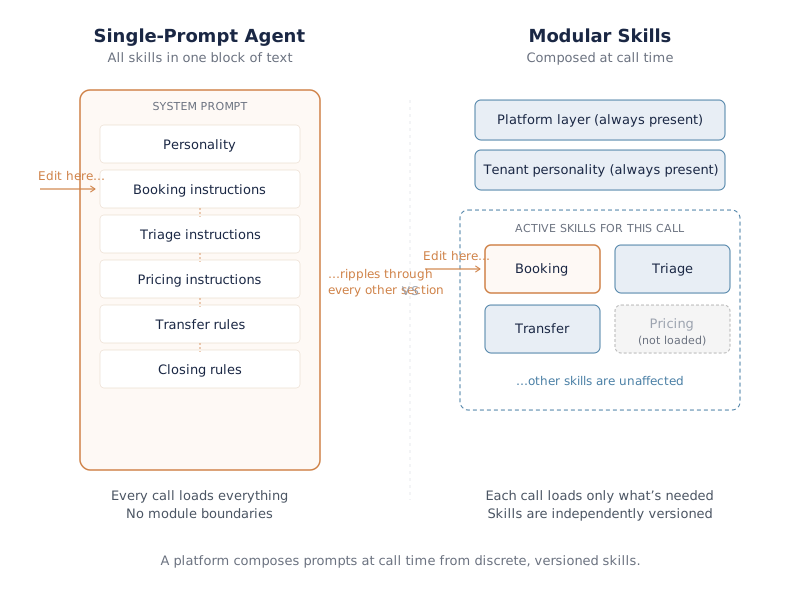
In a framework that ships a single system prompt per agent, every one of those skills lives in the same blob of text.
What goes wrong as skills accumulate
The failure modes are gradual, then sudden.
Prompt bloat. A prompt that started as 800 words to handle one job becomes 4,000 words to handle six. Most modern voice models can technically accept this, but the cost, the time-to-first-token, and the chance of the model losing track of an instruction all rise with prompt size. Every call pays the price of every skill, including the ones the caller will never invoke.
Instruction collision. Two skills disagree in subtle ways. The booking skill says "always confirm the time before ending the call"; the emergency-triage skill says "if the caller is in distress, transfer immediately without further questions." Live calls produce edge cases where the model picks the wrong rule. Tracing the regression back to which paragraph caused it is genuinely hard.
Editing one skill breaks another. Tighten the wording on after-hours behaviour to fix a missed escalation, and the booking skill suddenly starts asking unnecessary clarifying questions. Single-prompt agents have no module boundaries, so edits ripple in ways the editor did not intend. There is no equivalent of unit tests for a system prompt.
No conditional loading. Every skill is in scope on every call. There is no clean way to say "only load the booking skill if the caller actually wants to book" — the prompt is monolithic by construction. Tool calling already works the right way around: tools are described to the model and invoked only when relevant. Skills should behave the same way; in single-prompt frameworks, they cannot.
No per-skill measurement. When a customer asks "how often is our booking flow completing successfully?", a single-prompt agent has no concept of which calls were booking attempts. There is no skill-level success rate, no skill-level capture-data quality, no skill-level cost-per-completion. Everything is measured at the call level, and skills are inferred after the fact from transcripts.
What modular skills look like
A platform that treats skills as first-class addresses each of these directly.
A skill becomes a small, named, versioned unit. It has its own activation rules (when should the model consider this skill?), its own capture schema (what structured data does this skill produce when it completes?), its own completion signal (the model emits a structured event when the skill is done), and its own measurement surface (how often does it complete, how cleanly, at what cost).
The system prompt at call time becomes a composition: the platform layer (always present), the tenant's personality (always present), and the active skills for this tenant on this call. Skills can be enabled, disabled, A/B tested, version-pinned, or rolled back independently. A new triage skill can be released to one tenant for a soak period before being made available to the rest. A skill that under-performs can be swapped without touching anything else.
Crucially, the customer is not writing skills. They are configuring their business — "yes, take bookings; yes, escalate emergencies; no, do not quote prices" — and the platform composes the prompt accordingly. This is the same shift the original article described, applied one level down: customers are not configuring prompts, they are configuring outcomes.
Adjacent concerns the same architecture creates
A few other strains follow directly from single-prompt skills, and they are worth naming because they are usually treated as separate problems:
- Context window economics. Bigger prompts cost more per call and add latency to every turn, including turns that have nothing to do with the heaviest skill. A modular architecture only pays for what is loaded.
- Versioning and rollback. Without skill boundaries, "roll back the change to the booking skill" means restoring the entire prompt to a previous snapshot — including any unrelated improvements that have happened since.
- Per-skill experimentation. A/B testing a single behaviour across a population of tenants is straightforward when skills are modular and effectively impossible when they are merged into a single prompt.
- Capture data integrity. Skills that produce structured data need a schema attached to the skill itself, not bolted on afterwards via post-call analysis. Single-prompt agents typically reconstruct intent from the transcript, which is lossy and slow.
- Safe scope expansion. Adding a new behaviour to a single-prompt agent is a full-prompt rewrite, which means every existing behaviour is back in play for regression. Modular skills can be added without re-opening anything that already works.
Back to the customer's question
So — what happens when you want one agent to do six different things, and how does that fit in a single prompt?
The honest answer is: it fits, until it doesn't. Six skills in one prompt will work for a while. The bend points come quietly — a missed escalation that traces back to an instruction the model deprioritised because the prompt was too long; a booking confirmation that started asking the wrong question after an unrelated edit; a customer asking for a number you cannot produce because the architecture never separated the skills in the first place.
A framework gives you one prompt to fill in. A platform gives you a way to compose, version, measure, and improve many distinct behaviours independently — without your customers (or you) ever needing to think in prompts.
If the agent only ever has to do one thing, the single-prompt model is fine. The moment it has to do six, the architecture starts to bend, and the engineering work to keep it standing is no longer the work of running a business — it is the work of running a platform.